

Contents
Why Building a Website Should Be on Your 2026 New Year Resolution List
Introduction
January carries a unique energy. As a new year begins, many of us pause to reflect on where we are, where we want to go, and what we’re ready to commit to changing. New Year resolutions are not just hopeful intentions—they are decisions to take ownership of our direction and make progress that lasts.
For a growing number of people, that resolution involves creating something more permanent in their digital lives. One decision, in particular, unlocks long-term opportunities across careers, businesses, and creative projects: Build Website 2026
If you plan to launch a personal brand, start a side business, share your expertise, or support a community or nonprofit, now is the right moment to act. A website is no longer optional infrastructure—it is a foundational asset you own, control, and grow over time.
This article explains why you should build a website in 2026, why timing matters, and how modern tools have removed the traditional barriers that once made starting feel intimidating.
To build a website in 2026 is to invest in digital ownership, long-term visibility, and personal control. Unlike social platforms, a website is an asset you fully own—one that supports professional growth, business ideas, content creation, and community building. Platforms like WordPress.com make getting started fast and manageable, removing traditional technical barriers and making 2026 an ideal time to build a website that can grow with you.
If you’re planning to build a website in 2026, start by understanding how to protect and organize it from day one. Continue with our guide: The 2026 Digital Reset: How to Secure, Organize, and Protect Your Website from Day One .
Why Digital Ownership Matters More in 2026
Social platforms are powerful, but they come with a limitation that becomes more obvious every year: you don’t own them. Algorithms change, policies shift, and monetization rules evolve without notice. Creators and small businesses who rely entirely on these platforms often discover that visibility can disappear overnight.
Recent years have shown how quickly reach and engagement can decline when platforms prioritize paid promotion or adjust content distribution rules. Those who built only on rented platforms were forced to adapt rapidly. Those who invested in their own websites remained far more stable.
Building a website in 2026 reduces dependency on external platforms and restores control over your digital presence.
A website is fundamentally different from social content. Blog posts, pages, and resources remain searchable for years. A well-written article published in early 2026 can continue attracting visitors long after social posts have faded.
Search engines reward useful, well-structured content. Over time, your website compounds in value—each page strengthening overall visibility. Your site also becomes a central hub, with social media, email newsletters, videos, and podcasts all pointing back to one place you fully control.
The barrier to building a website has never been lower. AI-assisted writing tools, visual editors, and managed platforms have removed most technical friction. At the same time, expectations have risen—professionals, creators, and organizations are now assumed to have a web presence.
If you’ve been waiting for the right year to build a website, 2026 is that year.
Common 2026 Goals That Start with a Website
If your goal is career growth, consulting, freelancing, or showcasing expertise, a website gives you space to present yourself fully. Unlike profiles on third-party platforms, your website reflects your voice, values, and approach—without algorithmic constraints.
When someone searches your name, your website becomes your first impression. Building a website in 2026 means controlling that narrative.
For small businesses and side projects, a website provides essential infrastructure. It allows you to establish credibility, accept inquiries or payments, build an email list, and rank for customers who are actively searching for what you offer.
Social media alone is rarely enough for sustainable growth. A website becomes the operational core of your project.
Blogging remains one of the most effective ways to build authority online. Articles published on your website accumulate value over time, unlike social posts that disappear quickly. Each piece strengthens your visibility and credibility.
For educators, writers, and creators, building a website in 2026 creates a long-term publishing platform you fully own.
Websites provide legitimacy and coordination for nonprofits and community efforts. Volunteers, donors, and participants expect to find clear information online. A website becomes the central place for communication, updates, and engagement.
Without a website, even meaningful initiatives struggle to scale or sustain momentum.
What Holds People Back (And Why It Doesn’t Have To)
Modern platforms have removed the need for coding or server management. Visual editors, pre-built templates, and guided setup flows make it possible to build a website in 2026 without technical expertise.
A functional website can be live within days, not months. The time invested early in the year compounds through increased visibility, credibility, and opportunity.
Website creation is far more affordable than many assume. Entry-level plans often cost less than everyday subscriptions, while delivering long-term digital value.
You don’t need the perfect platform to begin. You need one that is reliable and flexible. Starting matters more than optimizing prematurely.
How WordPress.com Simplifies Getting Started
Getting started online shouldn’t require technical expertise or constant decision-making. WordPress.com is designed to reduce friction at the earliest stage—so momentum is built through progress, not setup.
A managed platform takes responsibility for hosting, updates, backups, and security. Instead of learning infrastructure, you focus on your content, goals, and direction.
Why this matters: Fewer technical decisions early on means fewer delays—and more consistency over time.
WordPress.com includes hosting, automatic updates, and baseline security by default. There are no servers to manage and no patches to apply manually—systems run quietly in the background.
Why this matters: Stability is established from day one, reducing long-term maintenance risk.
Professionally designed themes provide structure and consistency without requiring design skills. Customization happens visually, allowing you to shape your site while staying focused on content.
Why this matters: Good design becomes a starting point, not an obstacle.
Integrated AI tools support early creation by helping with:
- Drafting initial content
- Improving clarity and tone
- Creating outlines and headlines
Why this matters: Reduced friction helps ideas move to publication instead of stalling at the blank page.
From Idea to Live Website: A Realistic First-Month Plan
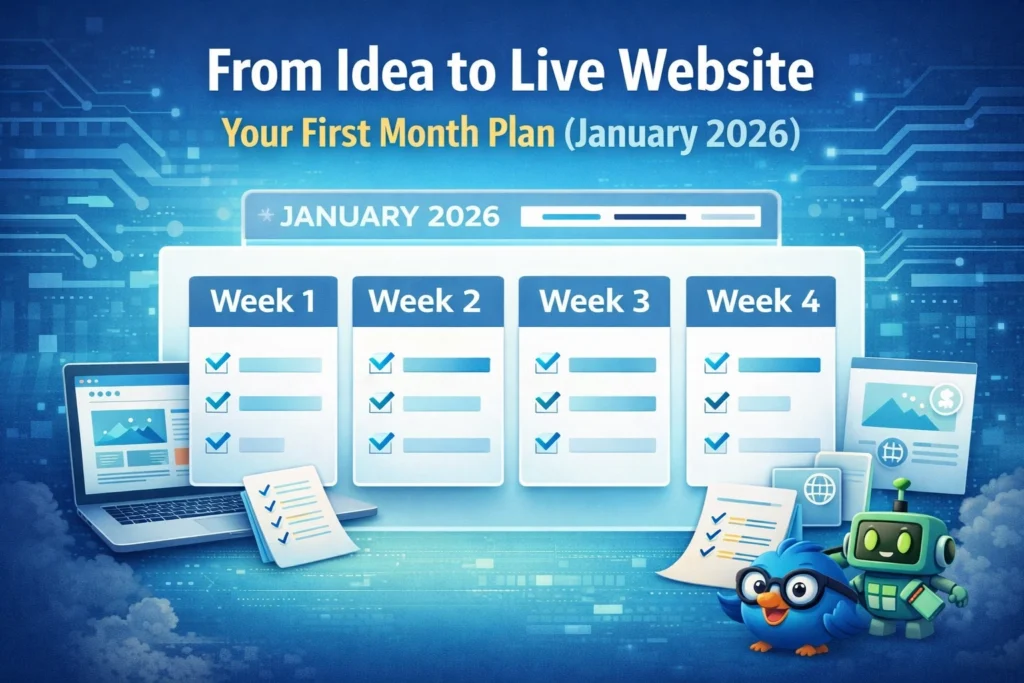
A Practical First-Month Website Plan
Clarify your goals, audience, and the core pages your site needs.
Publish essential pages and refine visuals to establish credibility.
Set up search visibility, internal links, and basic site structure.
Plan ongoing content, email capture, and promotion channels.
A live website in January is far more valuable than a perfect website delayed indefinitely.
Long-Term Benefits of Starting Now
Search engines favor established websites. Content published early in the year gains authority over time, increasing discoverability with every passing month.
Building and maintaining a website strengthens your ability to communicate value, understand your audience, and refine your message through real-world feedback.
Publishing a live website often creates momentum. Visibility leads to confidence, and confidence opens the door to opportunities you may not have anticipated.
Conclusion · Make It Your Resolution
To build a website in 2026 is to take ownership of your digital future. The technical and financial barriers that once made starting difficult have largely disappeared. What remains is a single decision: to begin.
A website supports nearly every meaningful goal—career growth, business development, creative expression, and community impact. It’s a long-term asset you build once and continue benefiting from year after year.
Choosing a reliable platform matters. A managed solution like WordPress.com allows you to focus on creating and growing, without getting distracted by hosting complexity or technical maintenance.
If January feels like a reset moment, make this the year you establish something permanent. Choose a platform. Define your purpose. Start small—but start. You won’t regret beginning in 2026.
After you build a website in 2026, learn how to protect it for the long term in our guide: The 2026 Digital Reset: How to Secure, Organize, and Protect Your Website from Day One .
Affiliate Disclosure: Some of the links in this article are affiliate links. This means we may earn a commission if you purchase through them, at no additional cost to you. We only recommend hosting providers we have tested, reviewed, or genuinely believe offer value to our readers.